
Finding St. Clair County Residents
A good search begins with the kind of fact already known. An exact street address points to the Assessor's parcel card. A full name may lead first to the Recorder's party index, a court party search, or a voter-status tool. An older name belongs in the Belleville Public Library collection, county histories, cemetery lists, or the Illinois Regional Archives Depository. No one roll contains every St. Clair County resident. Each record proves only the relationship printed in it.
Use two independent records when identity matters. A tax owner may receive mail elsewhere. A deed party may have sold the property long ago. A directory entry may predate a street renumbering. Record the year, office, document or parcel number, and the exact spelling shown before moving to the next source.
- Search DEVNET by owner name, address, or parcel identification number.
- Open the parcel map to confirm the place, township, and nearby lots.
- Run the Recorder's AVA index for deeds, liens, and other recorded instruments.
- Check the appropriate voter, court, vital, cemetery, or historical collection.
- Ask the correct custodian for an existing record that is not indexed online.
Start With St. Clair Parcels
The free St. Clair County Property Tax Inquiry, also called DEVNET wEdge, is the strongest first stop for a known address. Its Basic Search accepts a parcel number or owner name. Address Search separates house-number ranges, street name, and city. Sales Search adds sale dates and amounts, while Advanced Search can narrow results by tax year, township, property class, assessed value, and tax district.
| DEVNET field | Best use | Reading caution |
|---|---|---|
| Owner name | Find parcels on the tax roll | Ownership is not occupancy |
| House number and street | Find an exact or ranged address | Use situs, not mailing, address |
| PIN | Open one durable parcel identity | County format has 11 digits |
| Tax year and district | Separate similar results | Districts are not postal areas |
The parcel card can show the tax-record owner, owner mailing address, situs address, class, township, districts, assessed values, sales, legal description, and links to tax and GIS records. It does not name every person who lives there. The captured DEVNET search screen shows the county's actual starting point.
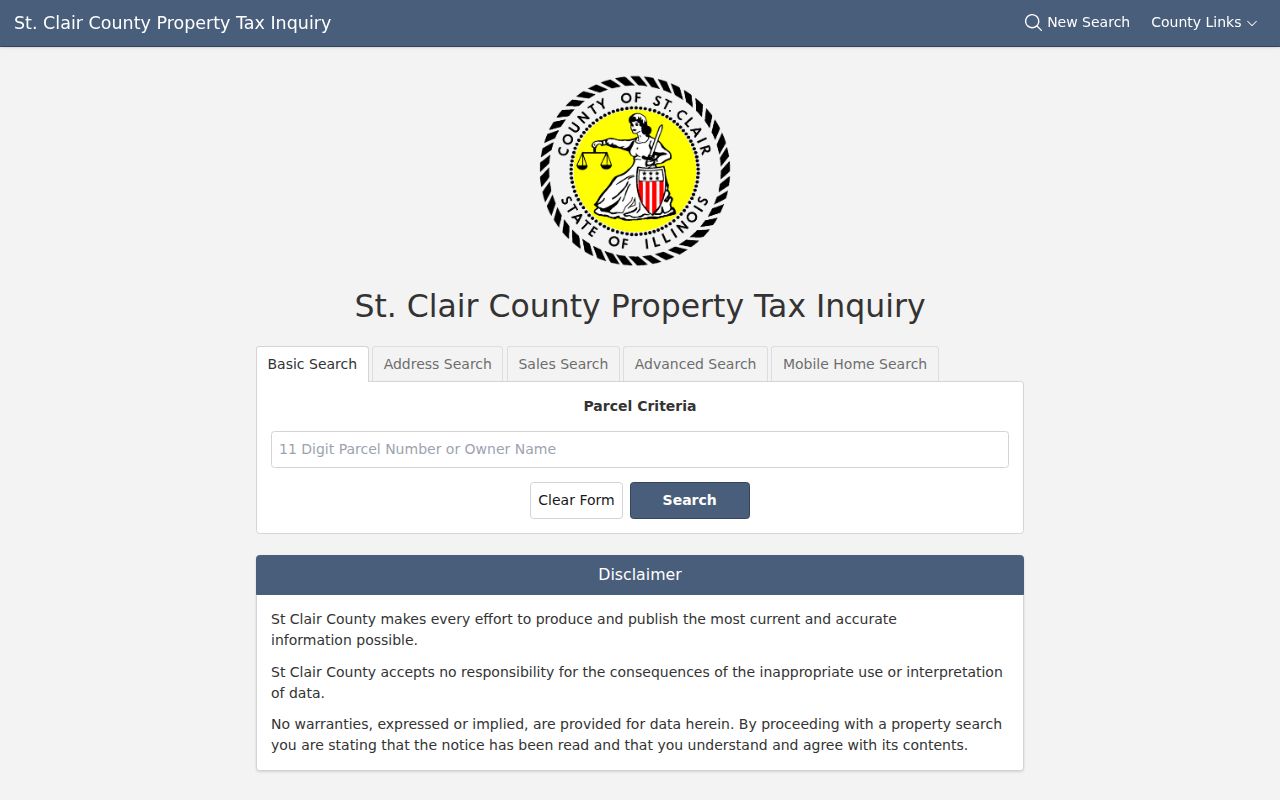
The separate tabs explain why a broad owner search and a precise address search can return different useful paths.
St. Clair Resident Record Keepers
Most county records begin at the Public Square courthouse in Belleville, but each office keeps a separate set. The Recorder handles deeds, mortgages, plats, liens, and annexation instruments. The Assessor maintains the assessment roll and parcel search. The County Clerk keeps local vital records and election services. Asking the office that owns the record saves time, especially when the desired year or image is not online.
All three list weekday hours of 8:30 a.m. to 5 p.m. GIS, the Treasurer, Circuit Clerk, Sheriff, and Building and Zoning answer different questions. Municipal records remain with the relevant city or village, not automatically with the county.
St. Clair Deed Index Paths
The Recorder offers four access channels. AVA is the free index-only route. It searches party name, recorded-date range, document number, document type, and parcel number, but does not supply document images. Tapestry EON is a pay-as-you-go index and image service. Laredo Anywhere is subscription access. Seven courthouse workstations provide free index searching in person, with copies charged by the page.
| AVA | Free index, no images |
|---|---|
| Tapestry EON | $8.75 search and $1 per printed page |
| Laredo | Monthly plans with image and PDF tools |
| Courthouse | Seven public terminals and staff copy routes |
Most documents from January 1986 forward can be reached through the online vendor routes. Older deeds and items not online may require a terminal, mail, phone, or email request. The AVA capture shows why a middle initial, date range, document type, or exact PIN helps separate similar party names.
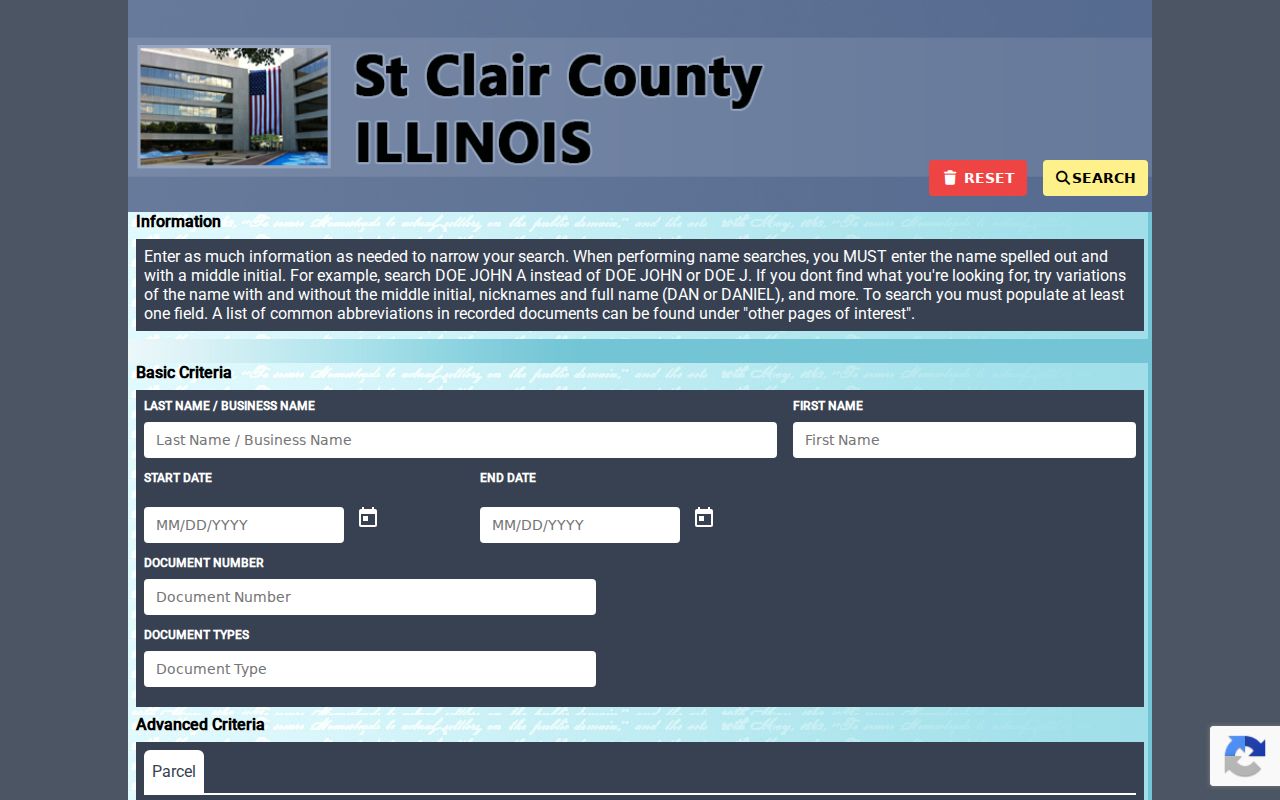
The screen is an index doorway, not proof of the document's full terms or a current address.
Current St. Clair Resident Rolls
Current directory work draws from records made for tax, land, election, court, and public-safety purposes. The right source depends on the relationship being tested. None should be treated as a master list of households.
| Official source | Relationship shown | Keeper | Access route |
|---|---|---|---|
| Assessment roll | Tax-record owner and parcel | County Assessor | Free DEVNET portal |
| Recorder index | Party to a recorded instrument | Recorder of Deeds | AVA, paid services, terminals |
| Voter tools | Registration and election details | County Clerk / state board | County and state lookup |
| Court index | Named party in a filed case | Circuit Clerk | Case search, docket, counter |
| Cemetery lists | Interment and burial location | City of Belleville | Online lists and sexton books |
Official rolls tend to state their keeper, year, and record purpose. Commercial people-finder products merge material from unknown dates and may attach the wrong relative or address. Use the official record whenever it exists, and confirm a name in a second source before drawing a conclusion.
Use resident records only for lawful personal research. Never use an address trail to stalk, harass, threaten, or harm anyone.
Map St. Clair County Records
The Parcel Map Viewer adds the place around a tax record. County GIS identifies parcel geometry, address points, street centerlines, incorporated places, townships, precincts, county-board districts, and zoning. Clicking a nearby parcel can supply a PIN that goes back into DEVNET. That makes GIS useful for checking whether the correct lot was found, especially where a postal city, township, and municipality do not match.
GIS still maps land, not household members. An adjacent parcel label gives a route to another public parcel card. It does not prove that the named owner is present or that unrelated people share the address. For a full address-led sequence, the St. Clair County street directory keeps the street and parcel questions together.
The captured county parcel viewer shows how the map provides context that a list of search results cannot.
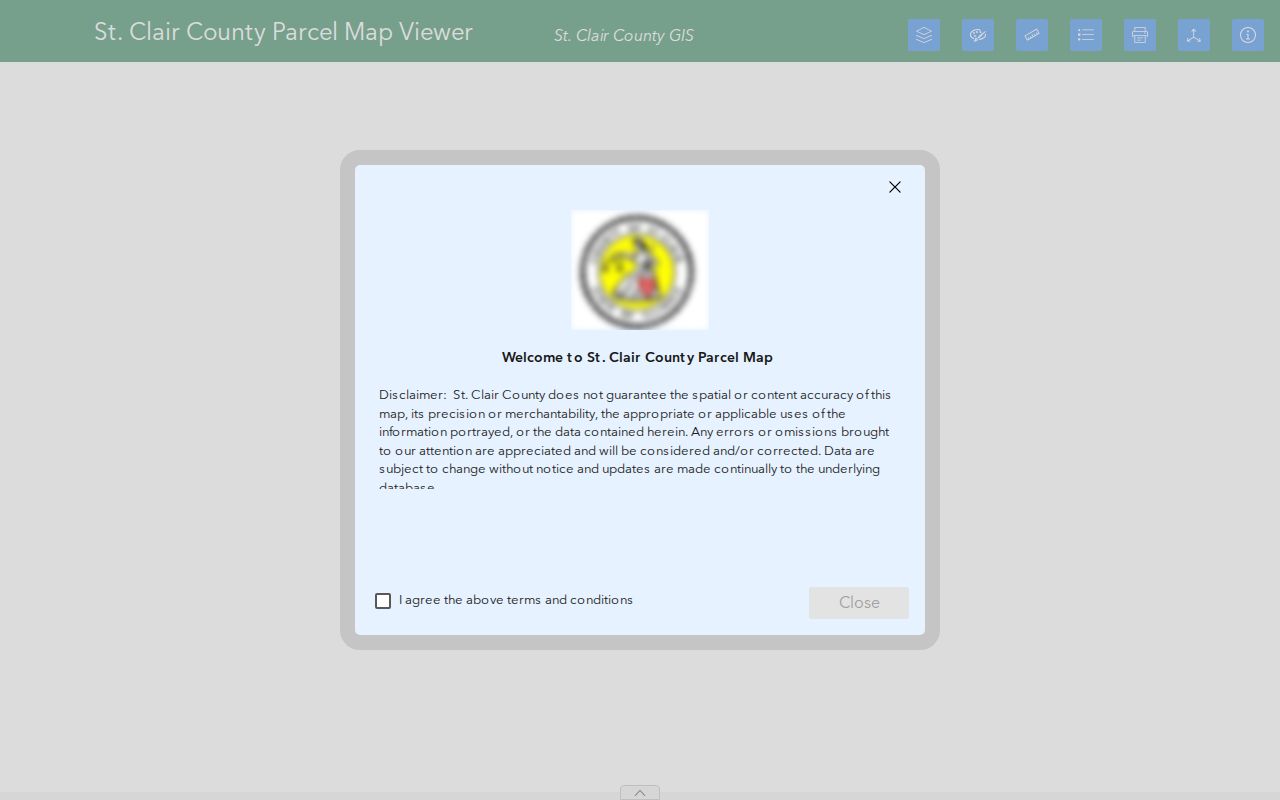
Use the mapped PIN and legal description as the bridge back to tax and deed records.
Labels in St. Clair Directories
Record labels are easy to overread. The tax roll's owner is the person or entity assessed for a parcel. A situs address is the physical site, while the mailing address is where the tax notice goes. A recorder index names a grantor, who transfers an interest, or a grantee, who receives one. A voter tool speaks to registration, not every occupant at an address.
- Parcel
- A mapped unit of land identified by a county PIN.
- Index
- A finding aid with names and document facts, not always the document image.
- Criss-cross directory
- A printed directory arranged by street address rather than only by surname.
- Roll
- An official list created for a defined public task, such as assessment.
Dates matter as much as names. DEVNET can show different tax years, a deed has a recording date, a court matter has filing and disposition dates, and a city directory represents one publication period. Preserve all of them in the search notes.
St. Clair Voter Search Limits
The County Clerk voter resources link registration status, polling place, vote-by-mail, and elected-official tools through a vendor frame. If that route fails, the Illinois State Board of Elections provides a statewide registration lookup. These tools help a voter check their own election information. They are not an open household roll.
Illinois places purpose limits on voter-file access, and the county vendor's public fields were not readable during research. Do not promise searches or output the interface may not offer. The state file route has its own eligibility, pricing, redaction, and permissible-use rules. A county or statewide registration result also should not be treated as proof that a person is at a street on the day of the search.
The captured voter resources screen identifies the official county doorway.
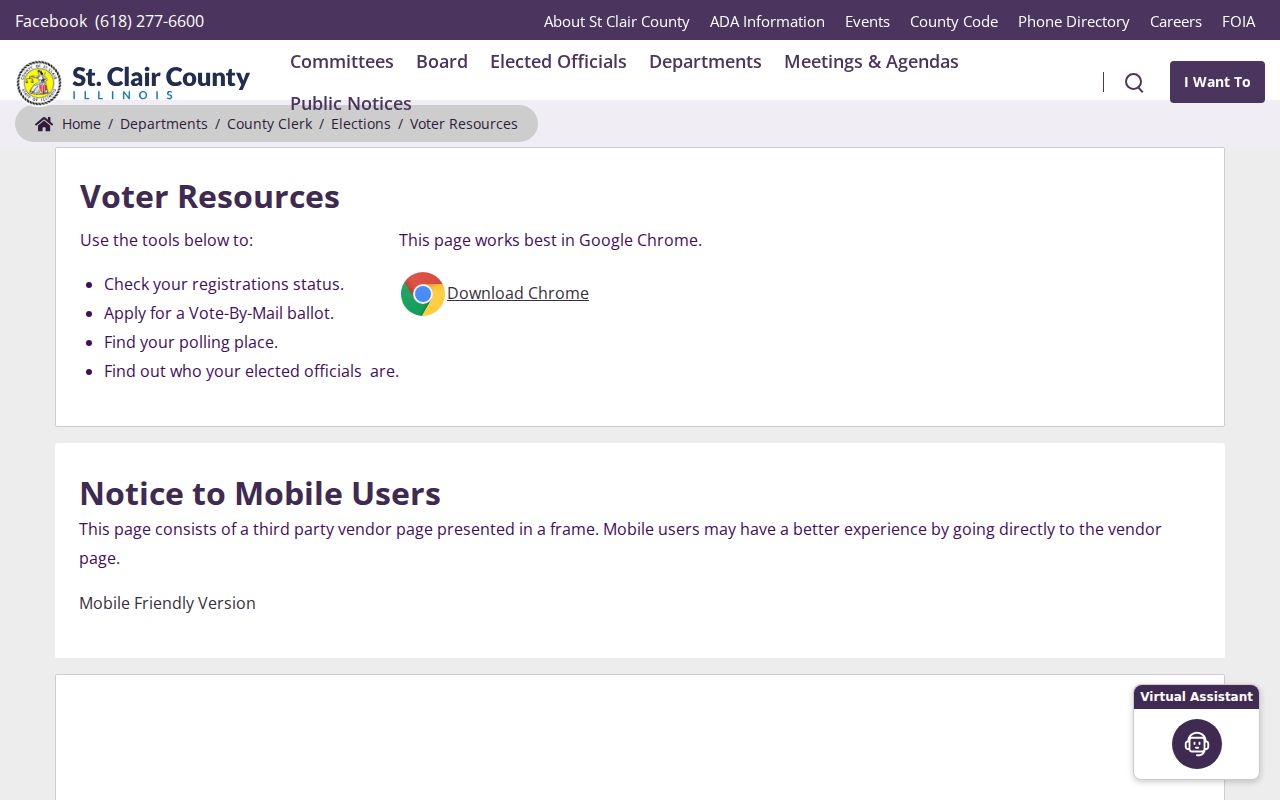
Use the statewide lookup as a fallback, then direct record questions to the elections division at the County Clerk.
Historic St. Clair Resident Directories
Belleville Public Library's Archives and Genealogy room holds city directories, local histories, newspapers, obituary material, yearbooks, and other sources for older residents. Digitized Belleville volumes include 1868-69, 1884, 1891-92, 1900, 1912, 1925, and 1935. The 1891-92 work is broader than a city list: it covers Belleville, East St. Louis, county towns, a classified business section, and farmers and landowners.
An entry may show a name, occupation, employer, spouse or widow notation, and residence. Its key explains short forms such as res, bds, wid, opp, and nr. Search the street section and nearby publication years when a surname is unclear. The digitized 1884 part has missing pages 78-79 and 111-112, so silence in that issue is not firm proof of absence. The complete shelf and reading method belong in the St. Clair County city directory collection.
Walnut Hill Resident Clues
Belleville's Walnut Hill Cemetery records form a rare municipal name index. Alphabetical lists cover 1855 through 2007 and 2008 to the present. Scanned sexton books run from April 16, 1855, through December 30, 2014. A separate Catholic cemetery book covers May 1888 through December 1899.
Older handwritten entries may add age, sex, birthplace, place and cause of death, residence, burial location, funeral home, and remarks. That detail can distinguish two people with the same name, but it does not prove ownership or residence at one street. Handwriting and transcription errors also make spelling variants essential.
The first known book is missing for roughly 1853 through April 1855. For that gap, check newspapers, church sources, other cemeteries, and library material rather than assuming no burial occurred. This local break is a good example of why the St. Clair County residents directory needs both an index and an archive fallback.
St. Clair Court Name Checks
The Circuit Clerk Court Record Search and docket pages are the local routes for current case information. A name hit means the person was listed as a party in a case. It does not state the final outcome by itself. Capture the case number, court division, filing date, party role, and disposition, then obtain the docket or document needed to understand the record.
The Circuit Clerk also offers courthouse access, copy requests, and the Clericus Magnus subscription route. Sealed, expunged, juvenile, and otherwise confidential material will not appear as an ordinary public result. For historical work, the Illinois Regional Archives Depository has a St. Clair County chancery index covering 1815 through 1870 with 2,508 indexed records. Archive requests can bridge a period far earlier than the modern portal.
Request Missing St. Clair Records
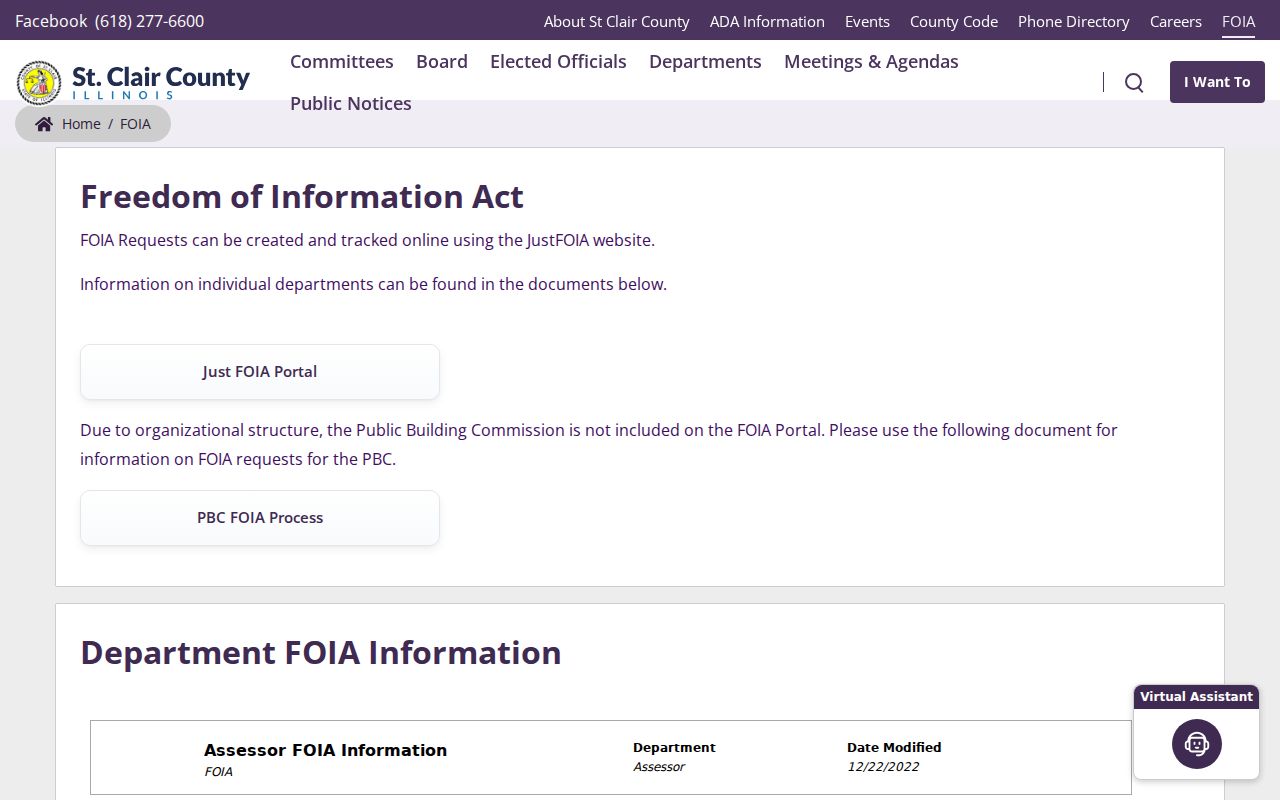
Illinois Freedom of Information Act requests are for existing public records, not for an office to investigate where a private person lives. St. Clair County accepts requests through its FOIA entry point and JustFOIA portal, subject to department rules and legal exemptions. Name the department, record category, date range, and preferred format. Ask to inspect or receive copies.
The ordinary response period is five business days, with a statutory extension of up to five more business days for listed reasons. The first 50 standard black-and-white pages are generally free under the Attorney General guidance, then the general rate is $0.15 per page. Other formats and certification can cost more. A separate confidentiality law still controls when it protects a vital record, voter information, court file, motor-vehicle record, or military discharge.
The captured county FOIA page helps identify the right public body before a request is filed.
For old records, the library, historical society, and IRAD may be faster and more complete than a modern department search.
St. Clair Custody Record Scope
Custody databases answer a narrow public-safety question. The St. Clair County Sheriff's Corrections page describes its jail search as current and updated hourly. The Illinois Department of Corrections search covers people now in custody or on parole. Federal Bureau of Prisons coverage begins in 1982. None of these sources is a complete life history, and a name match requires identity checks.
The captured St. Clair County jail search shows the official county route, although automated inspection was stopped by its verification screen.
Use the inmate-information phone route when the public screen does not open, and do not treat a missing result as proof of no past case or sentence.
The state IDOC individual in custody search is the next official channel when the county jail is not the relevant keeper.
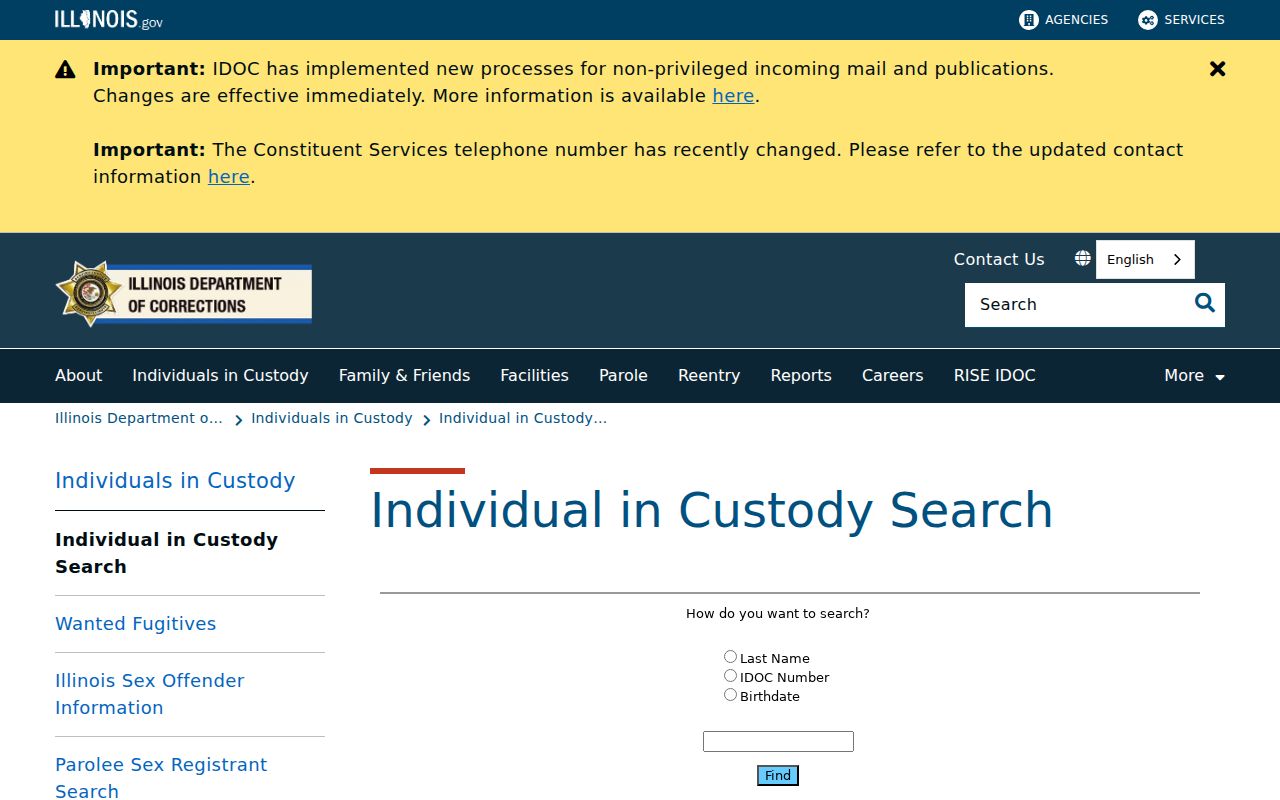
The state tool has a different scope from the local roster. Historical or post-sentence records may require an IDOC records request.
Verify Every St. Clair Record
Keep a compact research log. Note the source URL, date checked, tax or directory year, exact name, record number, and the relationship the record proves. Then compare it with a second source created for a different purpose. A parcel card paired with a deed can confirm ownership. A directory entry paired with a census or obituary can strengthen a historical household link. A court index paired with the docket can show the outcome rather than just the filing.
Protected addresses require special care. Illinois operates an Address Confidentiality Program, vital certificates have eligibility rules, voter data is restricted, DD-214 copies have tight access limits, and courts can seal records. Missing data may reflect a legal safeguard rather than a failed search. Do not try to work around it.
Finally, revisit the official source. Portals, fees, hours, and search coverage change. A dated screenshot explains how a tool looked when captured, while the custodian's live page controls the current route. That habit keeps a St. Clair County residents directory search accurate, fair, and useful.